

Међународни научни скуп посвећен савременим приступима у проучавању структуре, механике и физиологије мишићних система
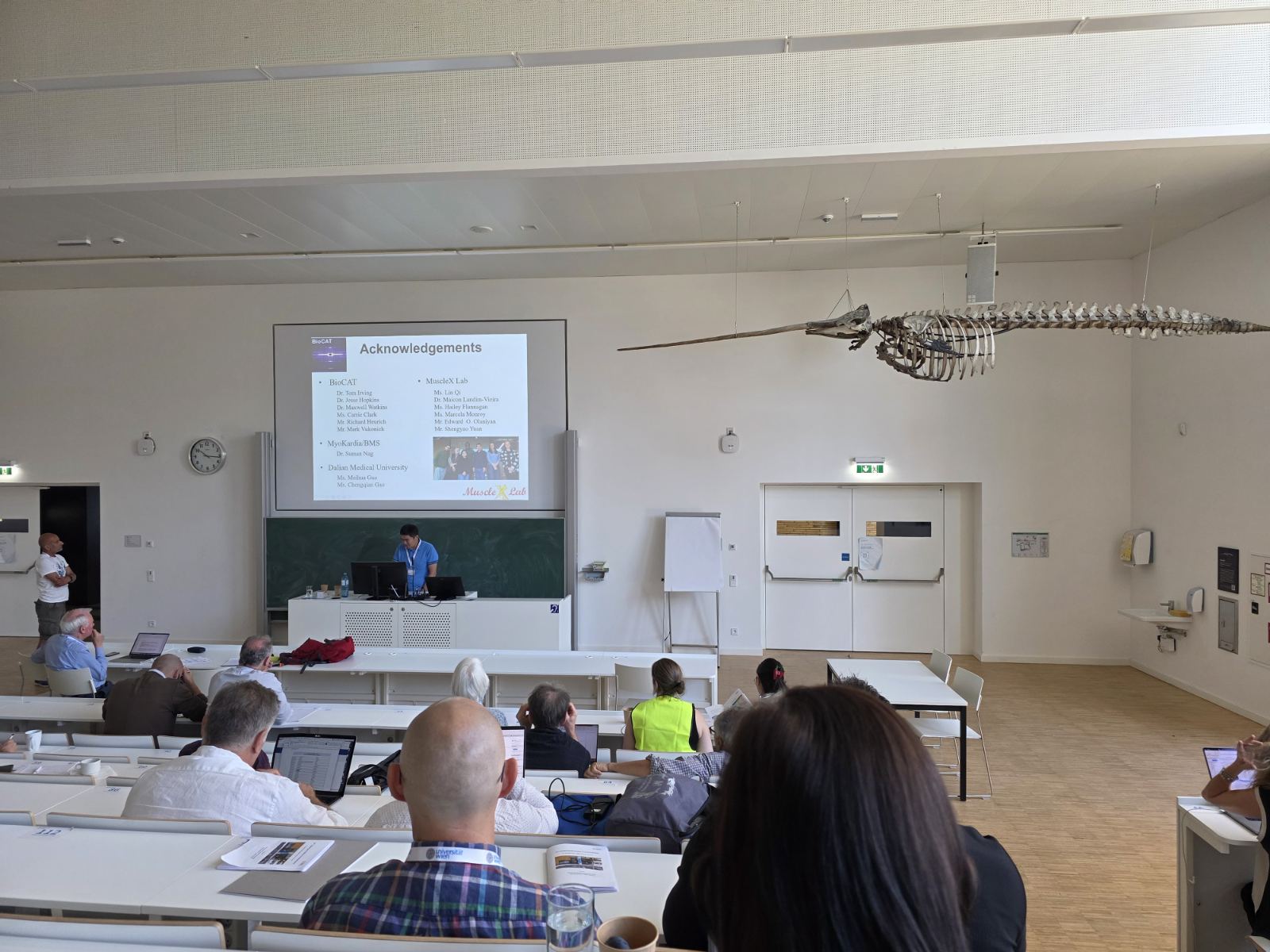
Истраживач Института за информационе технологије Универзитета у Крагујевцу, Момчило Продановић, учествовао је на 53. European Muscle Conference (EMC 2026), одржаној од 6. до 9. септембра 2026. године у Бечу, у организацији Универзитета у Бечу. Конференција окупља истраживаче из различитих области науке о мишићима, са фокусом на структуру и механику мишића, физиологију и патофизиологију, механизме миопатија, као и примену савремених метода рачунарског моделовања мишићних система.
У оквиру научног програма, Момчило Продановић представио је рад „Predicting Equatorial X-Ray Fiber Diffraction Patterns During Cardiac Twitch“, реализован у сарадњи са Анђелом Кафеџиски, Tомасом Ирвингом и Србољубом Мијаловићем, уз учешће истраживача из компаније FilamenTech, Inc., Универзитета у Београду и Illinois Institute of Technology. Истраживање представља пример интердисциплинарног приступа који повезује рачунарско моделовање, биомеханику и структурну анализу срчаног мишића. Рад је усмерен на развој рачунарског приступа за повезивање механике срчане контракције са структурним променама које се одвијају унутар саркомере. Комбиновањем модела MUSICO-Fiber и MUSICO-X, истраживање омогућава предвиђање промена у екваторијалним обрасцима рендгенске дифракције током срчаног трзаја, као и анализу појединачних структурних ефеката који се истовремено региструју експерименталним мерењима. Посебан значај овог приступа огледа се у могућности повезивања механичког понашања срчаног мишића са променама на нивоу саркомере, укључујући промене растојања између миофиламената и прерасподелу миозинских глава. На тај начин, рачунарско моделовање пружа додатни оквир за тумачење сложених структурно-функционалних односа који прате процес мишићне контракције.
Учешће на 53. European Muscle Conference представља значајну прилику за представљање истраживачких резултата Института у међународној научној заједници, као и за размену знања и искустава са истраживачима који се баве биомехаником, физиологијом и структуром мишића.
***
Scientific Contribution by Institute Researcher Presented at European Muscle Conference 2026
An international scientific meeting exploring contemporary approaches to muscle structure, mechanics, and physiology
Momčilo Prodanović, a researcher at the Institute for Information Technologies, University of Kragujevac, participated in the 53rd European Muscle Conference (EMC 2026), held from 6 to 9 September 2026 in Vienna and organized by the University of Vienna. The conference brings together researchers from diverse fields of muscle science, with a focus on muscle structure and mechanics, physiology and pathophysiology, mechanisms underlying myopathies, and advanced approaches to computational modelling of muscle systems.
As part of the scientific program, Momčilo Prodanović presented the study “Predicting Equatorial X-Ray Fiber Diffraction Patterns During Cardiac Twitch,” conducted in collaboration with Anđela Kafedžiski, Thomas Irving, and Srboljub Mijailović, with contributions from researchers at FilamenTech, Inc., the University of Belgrade, and the Illinois Institute of Technology. The research demonstrates an interdisciplinary approach combining computational modelling, biomechanics, and structural analysis of cardiac muscle. The study focuses on developing a computational framework that connects the mechanics of cardiac contraction with structural changes occurring within the sarcomere. By combining the MUSICO-Fiber and MUSICO-X models, the research enables the prediction of changes in equatorial X-ray diffraction patterns during cardiac twitches and provides a means of analyzing individual structural effects that are experimentally observed simultaneously. A key aspect of the approach is its ability to relate the mechanical behavior of cardiac muscle to structural changes at the sarcomere level, including variations in myofilament spacing and the redistribution of myosin heads. Computational modelling in this context provides an additional framework for interpreting complex structure–function relationships underlying muscle contraction.
Participation in the 53rd European Muscle Conference provided an important opportunity to present the Institute’s research to the international scientific community and exchange knowledge with researchers working in muscle biomechanics, physiology, and structural biology.